

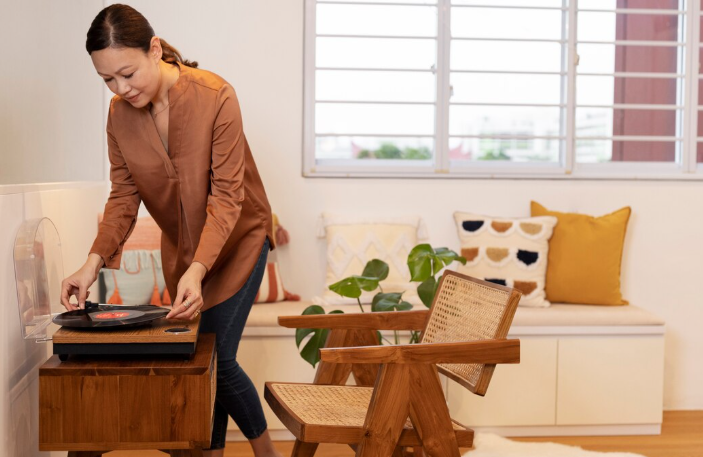
You have a couch. A couple of chairs. A coffee table. A TV. You push the couch against the wall. You put the chairs across from it. You place the coffee table in the middle. Your room looks like a waiting room—not a home.
Arranging furniture is not about following rules. It is about creating conversation, flow, and function. A well-arranged living room invites people to sit, talk, and relax. A poorly arranged room makes people feel awkward and uncomfortable.
The good news: You do not need an interior designer. You need a few simple principles. This guide will teach you how to arrange living room furniture for any shape and size—from tiny apartments to open floor plans.
Part 1: The Golden Rules of Furniture Arrangement
Before moving a single piece of furniture, understand these five principles.
Rule 1: Create a Focal Point
Every living room needs one thing that draws your eye when you walk in. This anchors the room.
Common focal points:
- Fireplace (most traditional)
- TV (most common in modern homes)
- Large window with a view
- Large piece of art or gallery wall
- Bookcase or media console
If you have no natural focal point: Create one. Place a large piece of art on the main wall. Arrange furniture to face it. Or make a media console with a large TV the focal point.
Arrange furniture around the focal point. Sofas and chairs should face it or be angled toward it.
Rule 2: Prioritize Conversation (Not the TV)
Many people arrange everything to face the TV. Then they wonder why guests sit silently watching a dark screen instead of talking.
The fix: Create a conversation area where seats face each other. Sofas and chairs should be close enough to speak at normal volume (no shouting across the room). Ideal distance: 4–8 feet between seating.
Test: Sit in each seat. Can you make eye contact with someone in another seat without straining your neck? If not, rearrange.
Rule 3: Float Furniture (Away from the Walls)
The most common mistake is pushing every piece against the wall. This makes the room feel larger? Actually, it makes the room feel like a bowling alley.
Float furniture means pulling it away from the wall into the room. Even 6–12 inches makes a difference. A sofa floating in the room creates a pathway behind it and makes the space feel intentional.
When to float: Almost always. Exception: very tiny rooms (under 10×10 feet) where space is truly tight.
Rule 4: Define Traffic Flow
People need to walk through the room without weaving around furniture. Create clear paths.
Minimum walkway width: 24–30 inches for one person. 36–48 inches for main walkways.
Do not block: Doorways (keep clear), the path to the kitchen, access to windows, access to the TV viewing area.
The test: Walk from your front door to your kitchen. Walk from your sofa to the bathroom. Are you tripping over coffee tables or squeezing between chairs? Move furniture out of those paths.
Rule 5: Scale and Proportion
A giant sectional sofa in a tiny apartment overwhelms the room. A tiny loveseat in a large great room looks lost.
| Room Size | Appropriate Sofa Size |
|---|---|
| Small (under 120 sq ft) | Loveseat (50–60 inches) or apartment-sized sofa (60–70 inches) |
| Medium (120–200 sq ft) | Standard sofa (72–84 inches) |
| Large (over 200 sq ft) | Extended sofa (84–96 inches) or sectional |
Coffee table rule: Height should be equal to or 1–2 inches lower than the sofa seat height. Length should be about two-thirds the length of the sofa.
Rug rule: Front legs of all seating should fit on the rug (at minimum). Best: all legs of all seating on the rug.
Part 2: The 5 Basic Layouts (For Any Room Shape)
Choose the layout that fits your room and lifestyle.
Layout 1: The Conversation Circle (Best for socializing)
Best for: Living rooms where you entertain guests, talk, and play games. TV is secondary.
How to arrange:
- Sofa facing the focal point (fireplace or window)
- Two armchairs opposite the sofa (facing the sofa)
- Coffee table centered between all seats
- All seating within 4–8 feet of each other
Variation: Use a sectional sofa with one chair opposite the chaise.
Best room shape: Square or slightly rectangular.
Layout 2: The TV Focus (Best for movie watching)
Best for: Media rooms, family rooms, or anyone who watches TV daily. Still allow conversation.
How to arrange:
- Sofa directly facing the TV (not angled)
- TV at eye level when seated (center of screen at 42 inches from floor)
- Secondary seating (chairs or loveseat) perpendicular to sofa, angled toward TV
- Coffee table within arm’s reach of all seats
Do not: Put seating so far from the TV that you need binoculars. Measure viewing distance: for a 65-inch TV, 8–12 feet is ideal.
Layout 3: The L-Shape (Best for open floor plans)
Best for: Large rooms or open-concept spaces where the living room flows into dining or kitchen.
How to arrange:
- Sectional sofa forms the L
- Open end of the L faces the focal point
- No additional seating needed (or one accent chair)
- Rug anchors the entire seating area
Define the zone: Use a large rug to visually separate the living area from the dining or kitchen area.
Layout 4: The Balanced Symmetry (Best for formal spaces)
Best for: Formal living rooms, traditional homes, rooms with a fireplace.
How to arrange:
- Sofa centered on the fireplace (or focal point)
- Two matching armchairs flanking the fireplace (or opposite the sofa)
- Two matching end tables with matching lamps
- Coffee table centered
Why it works: Symmetry feels calm, formal, and intentional. Perfect for entertaining guests you want to impress.
Layout 5: The Small-Space Solution (Best for apartments)
Best for: Tiny living rooms (under 10×12 feet) or studio apartments.
How to arrange:
- Sofa against the longest wall (yes, sometimes you have to break the float rule)
- No coffee table (use a C-table or small side table that tucks over the sofa)
- Nesting tables instead of one large coffee table (pull out only when needed)
- Floor lamps instead of table lamps (saves surface space)
- Ottomans that double as storage and extra seating
- Wall-mounted TV (no bulky stand)
Multipurpose furniture: A futon, daybed, or sleeper sofa if this is also a guest room. Ottomans with hidden storage. Folding chairs kept in a closet.
Part 3: Arranging by Room Shape
Square Room (Equal length and width)
Challenge: A square can feel like a box. Everything pushed to the walls makes the center feel empty.
Solution: Float furniture. Place the sofa in the center of the room, facing the focal point. Leave 36–48 inches behind the sofa for a walkway. Place chairs angled toward the sofa.
Pro tip: Use a round coffee table. A square table in a square room feels too rigid.
Rectangular Room (Longer than wide)
Challenge: The “bowling alley” effect. Most living rooms are rectangles.
Solution: Divide the room into two zones. Zone 1: seating area with sofa and chairs. Zone 2: something else (desk, reading nook, game table, bookshelves). Do not place all furniture in one long line.
Arrange furniture perpendicular to the long wall (not parallel). Place the sofa across the narrow dimension of the room. This visually widens the space.
Long, Narrow Room (Extreme rectangle)
Challenge: Like a hallway with windows.
Solution: Create two distinct conversation areas. Area 1 near the entrance: two chairs with a small table. Area 2 further in: sofa, coffee table, and TV. Walkway runs between them along one wall.
Avoid: Placing a long sofa parallel to the long wall. It makes the room look even longer.
L-Shaped Room (Two rectangles joined)
Challenge: Awkward corner where the two rectangles meet.
Solution: Use the corner as your anchor. Place a sectional sofa that follows the L shape. Or place a sofa in one leg of the L, chairs in the other leg. Define each area with its own rug.
Do not: Try to fill the entire L with one seating arrangement. It will feel forced.
Open Floor Plan (Living + Dining + Kitchen)
Challenge: No walls to anchor furniture. Everything can float away.
Solution: Use rugs as “floor anchors.” One rug defines the living area. Another rug defines the dining area. Rugs should not touch—leave a 12–24 inch gap of bare floor between zones.
Furniture placement: Back of the sofa often faces the dining table or kitchen. This creates a natural wall. Place a console table behind the sofa (facing the kitchen) to define the edge.
Part 4: Furniture Placement Specifics
Sofa Placement
| Do | Do Not |
|---|---|
| Float 6–12 inches from wall | Push directly against wall |
| Place sofa facing the focal point | Block a window with the sofa back |
| Leave 30+ inches to walk in front | Cram sofa into a corner |
| Align sofa on a rug (front legs on) | Let sofa stick into a walkway |
Coffee Table Placement
- Distance from sofa: 14–18 inches (close enough to reach a drink, far enough to walk between)
- Distance from facing chair: 14–24 inches
- Center it between all seating (not perfectly centered on the room)
TV Placement
- Center of TV at 42 inches from floor (eye level when seated)
- Distance from seating: 1.5–2.5 x diagonal screen size
- Do not place TV above a fireplace. (Neck strain. Also, heat damages electronics. Also, it is ugly.)
Rug Placement
| Room Size | Rug Size | Placement |
|---|---|---|
| Small (under 10×12) | 5×7 or 6×9 | Place under coffee table; front legs of sofa on rug |
| Medium (10×12 to 12×16) | 8×10 | All legs of seating on rug (ideal) |
| Large (over 12×16) | 9×12 or larger | All seating fully on rug |
Wrong rug size: A rug that is too small (like a postage stamp under the coffee table) makes the room look smaller, not larger.
Lamp and Lighting Placement
- End tables: Lamps should be at seated eye level (24–28 inches tall)
- Floor lamps: Place next to sofas or chairs, behind the seating line
- Overhead lighting: Use dimmers. Harsh overhead light kills cozy vibes.
- Three layers of light: Ambient (overhead), task (reading lamps), accent (picture lights, sconces)
Part 5: Troubleshooting Common Problems
Problem: “My room feels too crowded.”
Fixes:
- Remove one piece of furniture (yes, you have too much)
- Replace bulky furniture with smaller scale
- Use nesting tables (can tuck away)
- Use a smaller rug (86-inch sofa needs a 8×10 rug, not 9×12)
- Float furniture less (pull closer to walls in tiny rooms)
Problem: “No one ever sits in the chair over there.”
Fixes:
- The chair is too far from conversation. Move it closer.
- The chair faces the wrong way. Angle it toward the sofa.
- The chair is blocked by the coffee table. Move the table.
Problem: “People walk between the TV and the sofa.”
Fixes:
- Create a walkway behind the sofa, not in front of it
- Float the sofa away from the wall, walk behind it
- Place a console table behind the sofa to block accidental wandering
Problem: “The room feels like a furniture showroom.”
Fixes:
- Too symmetrical. Move one chair to a different angle.
- Too many matching sets. Mix upholstery, wood tones, and styles.
- Too much against the wall. Float something.
- No decor. Add plants, pillows, books, art.
Problem: “My sectional doesn’t fit.”
Fixes:
- Sectionals need 80–100 inches along the wall. Measure before buying.
- If already owned and too large: Split it (some sectionals come apart). Use the chaise as a separate piece.
Part 6: Essential Measurements (Keep This Cheat Sheet)
| Item | Measurement |
|---|---|
| Minimum walkway space | 24–30 inches |
| Main walkway space | 36–48 inches |
| Coffee table to sofa distance | 14–18 inches |
| Coffee table height | Same or 1–2 inches lower than sofa seat |
| Seating to TV distance (65-inch TV) | 8–12 feet |
| TV center height | 42 inches from floor |
| Sofa to facing chair distance | 48–96 inches |
| Standard sofa depth | 35–40 inches |
| Standard loveseat width | 50–60 inches |
| Standard sofa width | 72–84 inches |
| Standard doorway width | 30–36 inches (make sure furniture fits through) |
Part 7: Step-by-Step Arranging Process
Follow these steps in order.
Step 1: Empty the room. (Push everything to the center or remove it entirely.)
Step 2: Establish the focal point. Identify it. Face furniture toward it.
Step 3: Place the largest piece first. Usually the sofa. Position it facing the focal point. Float it 6–12 inches from the wall.
Step 4: Add secondary seating. Chairs across from or perpendicular to the sofa. Test conversation distances.
Step 5: Place the coffee table. Center it among seating. Measure 14–18 inches from sofa.
Step 6: Add end tables. Beside the sofa and chairs. Within arm’s reach of each seat.
Step 7: Add lamps. At least one light source per seating area.
Step 8: Place the rug. Under the front legs (minimum) or all legs (best).
Step 9: Add art, pillows, plants, books. The room is not finished until it feels lived in.
Part 8: Before and After Examples
Example 1: The All-Against-the-Wall Room
Before: Sofa against far wall. Two chairs against side walls. Coffee table stranded in the middle. No one can hear each other. TV is 15 feet away.
After: Sofa floated 24 inches from far wall. Chairs pulled in, angled toward the sofa. Coffee table centered 16 inches from sofa. Walkway behind sofa. TV moved to appropriate distance. The room feels half the size (in a good way) and twice as cozy.
Example 2: The Bowling Alley (Long Narrow Room)
Before: Sofa and loveseat in a line along the long wall. TV at one end. People at the far end cannot see. No conversation possible.
After: Two zones created. Near the entrance: two chairs with a small table (reading nook). Further in: sofa facing TV, one chair perpendicular. Walkway runs along the window wall. Room now functions as both a TV room and a reading room.
Example 3: The Floating Sofa (Open Floor Plan)
Before: Sofa floating in the middle of a great room with no anchor. The room feels chaotic. No one knows where the living area ends and the dining area begins.
After: Large 8×10 rug defines the living area. Sofa placed at the edge of the rug, facing the TV on the opposite wall. Console table behind the sofa (facing the dining table). Walkway between sofa and dining table. Two distinct zones created without a single wall.
The Bottom Line
Arranging living room furniture is not about rules—it is about people. Where will people sit? How will they talk? How will they walk? How will they feel?
The five most important tips:
- Float furniture away from walls (even 6 inches helps).
- Create conversation areas where seats face each other.
- Define clear walkways (30+ inches).
- Use rugs to anchor seating (front legs at minimum).
- Test and adjust after living with it for a week.
Do not try to get it perfect on the first try. Live with an arrangement for 3–5 days. Notice what annoys you. Then move one thing. Repeat until the room works for you—not the other way around.
Now go push your sofa away from the wall. Your living room is waiting.
Quick checklist (print and use):
- [ ] Focal point identified (fireplace, TV, window, art)
- [ ] Sofa faces focal point
- [ ] Sofa is floated (not touching wall)
- [ ] Walkway is 30+ inches clear
- [ ] Seating is 4–8 feet apart (can speak normally)
- [ ] Coffee table is 14–18 inches from sofa
- [ ] All seating has access to a table or surface
- [ ] Rug is correctly sized (front legs on or all legs on)
- [ ] TV is at eye level (42 inches to center)
- [ ] Room has at least three light sources
- [ ] No doorways or paths are blocked
- [ ] You have removed at least one piece of furniture you do not need

Dexter Harlow lives and breathes celebrity culture. From red carpet moments to the latest viral gossip, he brings Hollywood to your screen with flair and insider insight. Known for his sharp wit and captivating storytelling, Dexter keeps fans hooked, delivering the hottest entertainment news before anyone else.