

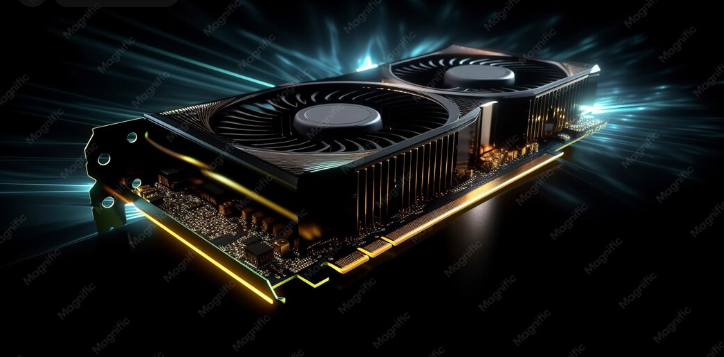
Confusion over the various chipsets found in modern graphics cards can be enormous, especially when looking at the graphics cards of large brands, which in seemingly equal specifications can have a huge difference in performance. In this article we take a closer look at the main component of a graphics card, the GPU chipset, and its architecture, and explain how this affects the performance of a graphics card.
What exactly is a GPU chipset?
A GPU chipset is the actual processor on a video card. This chip contains thousands of cores to handle many parallel calculations. Each core can perform a lot of sequence calculations but is especially suited for large amounts of parallel calculations. Many components are part of the architecture of a GPU. For example, there are many shader units (also called cores), many texture mapping units and many render output units. A memory controller manages the memory on a video card. The memory on a graphics card consists of video memory which is on the graphics card.
At the heart of every graphics card is the chipset. For the purposes of this explanation the term GPU chipset will be used, as the GPU (Graphics Processor) is the main processing unit on a graphics card. As well as the GPU the chipset contains the various other components that make up the heart of the graphics processing system. These are the Shader processing units, the Texture Mapping Units, the Render Output Units and the Memory controllers. In modern graphics processing these various components are combined into a single, unified architecture.
Architecture drives everything
At the core of any chipset are the cores that are grouped in clusters. The architecture of a GPU is therefore organized in clusters. An example are the so-called Turing-Architecture GPUs from NVIDIA or the RDNA architecture from AMD. The clustering of cores in a chipset serves to process different types of data. In the Turing Architecture, for example, there is the Cluster, the Execution Cluster and the SM (Streaming Multiprocessor). In the RDNA architecture, on the other hand, there are the CUs (Compute Units) and the RAU (Render-).
Another thing that affects a GPU’s performance is the manufacturing process that was used to make the GPU. The number of transistors per square centimeter on a 7nm GPU is many times higher than on a 14nm GPU. This means that a 7nm GPU will provide much better performance per watt than a 14nm GPU of similar design. For example, a 7nm GPU would be around 20-30% faster than a 14nm GPU of similar design while also using less power.
Other aspects of a graphics card specifications include the clock speed. We therefore have a base clock speed which is guaranteed by the manufacturer. The boost clock speed on the other hand is the highest speed which the GPU is able to reach under ideal circumstances. The actual performance however typically lies somewhere in between.
Different workloads tell different stories
This GeForce GTX 1650 has been designed to handle most current games at 1080p. While shader performance can be affected by many things such as a computers RAM, Graphics Drivers and cooling system the main specs that you need to look at are the Shaders and the Memory Bandwidth as these two have the largest effect on how well a GPU will be able to run a game at its highest settings. The NVIDIA GeForce GTX 1650 chipset has 896 CUDA Cores making up the 128 Shaders and the graphics card has a Memory Bus Width of 64 Bit with 4 GB GDDR6 Memory providing it with 48 GB/s of Memory Bandwidth. When looking at these specs for the GeForce GTX 1650 we can see that the lower end cards may not be able to run all games at their highest settings but they should be able to run most games at 1080p. The GeForce GTX 1650 should handle games such as Overwatch, Apex Legends, PlayerUnknowns Battlegrounds and Rocket League at very high settings. Lower end specs such as the 3GB version of the GeForce GTX 1650 may struggle in some cases so you may have to lower the settings in order to achieve smooth and stable frame rates. You can then increase the settings as needed in order to get the best possible experience from your computer. As with all things in life you get what you pay for so while the GeForce GTX 1650 may not be able to run all games at their highest settings it should still be able to handle most at 1080p.
Video production also requires unique processing in GPUs to enhance the work of video editors and 3D modelers and designers. Certain GPUs have hardware-based video encoders that perform the work of compressing video to file, freeing up the GPU’s cores for other tasks. There are also GPUs with large numbers of Ray Tracing Units (RTUs), which handle the complex mathematical processing required for the very realistic images used in many scenes, and these allow for realistic lighting and accurate casting of shadows in complex scenes.
This brings home another important point regarding GPU architecture and chipset design: as previously stated, raw compute power does not equal real world performance in certain scenarios. When it comes to the various workloads that a GPU can go through, there are different architectures that are better suited for certain tasks. Therefore, the chipset design of a GPU is very important to consider in terms of overall performance.
Memory bandwidth matters more than you think
The memory controller is another critical portion of the chipset as it connects the core processing element(s) of the graphics chipset to the graphics processor, and then to the graphics video random access memory (video RAM). The memory itself can be of any flavor or type (such as SDRAM, RDRAM, VRAM, etc.) and is used to temporarily store graphics data until it is processed by the graphics processing element(s).
The memory bus width in a graphics chip also has an enormous influence on the relationship between the cores and the memory. The width of the memory interface allows a greater amount of memory bandwidth at the same memory frequency. However, the memory itself can also compensate for a lower bus width by higher memory frequency. Examples for such high-frequency memories are GDDR6 or HBM2. The cache memories are also integrated in the chipsets and deliver a lot of support for the memory. They store the loaded data in the close proximity of the cores, thus enabling a fast access.
Heat changes everything
Just to elaborate on how every single chipset is designed to operate within strict Thermal and Power boundaries. When first put through their paces in a series of benchmarking tests (which can provide slightly inflated results compared to subsequent gaming performance), a number of factors are in play including a graphics card’s internal throttling down within set parameters in order to remain safe for extended periods of operation. Thus when initially putting a new graphics card through its paces in order to gain a feeling for its overall performance in a series of tests designed to provide the most realistic results possible in subsequent gaming performance, it is crucial to remember that the numbers which are achieved during these initial tests may not be entirely reflective of subsequent gaming performance.
The Total Graphics Power (TGP) of a graphics subsystem is another specification that should not be neglected. The TGP is measured in Watts and indicates the total power that the entire graphics subsystem including the GPU, memory and interface dissipates. It is an important specification because it indicates how hot a card can get during operation. As a rule, higher TGP values require more powerful cooling systems. However, a lower TGP does not automatically mean a worse graphics processing. There are many chipsets on the market that have been designed to be very efficient. These chipsets are able to achieve a high level of performance while at the same time using less power than less efficient designs.
Specifications don’t tell the whole story
But how many cores does a chipset have? Just like in every other processor, in graphics chips there are cores which are able to execute tasks. Also in graphics processing units (GPUs) there are cores which are responsible for processing data. However, they are also divided into clusters and each cluster has its very own task. For that reason, there are currently lots of GPUs with relatively few cores but which are nevertheless better than their competitors with more cores. The model in question is often an older one but that does not necessarily mean it is worse. There are some older GPUs which have been optimized in such a way that they are still better than their newer competitors.
But additional memory on a graphics card can also increase performance of work done at a specific resolution, as this increases the amount of graphics memory available to fill the gap between the card’s processing power and memory. Just as with the returns on additional CPU, the returns on additional memory will however dwindle rapidly as the card’s processing power is not increased to match.
Some graphical chipsets are continually improved by their driver package, months and even years after the initial launch to market. For example, a NVIDIA GeForce GTX 1650-based system may see increased gaming performance some time after the initial review has taken place and the artist has returned to their work on the development of the chipset’s performance for end-users. A review by an artist, such as myself, provides a reality check on the various options on the market for anyone planning to purchase a number of graphics processing chips of late, but they must be kept in mind that there is continued improvement of various chipsets by their respective driver packages over time to continue to meet artists and other end-users’ needs in the work that they do. This results in these items providing greater value as time goes on.
The reality check
In summary, the main factor determining the performance potential of any given graphics card is its chipset. When looking at the performance potential of graphics chips, key technical factors, how different graphics chip designs balance performance with power consumption, and how various different models trade performance, all must be looked at. This will allow users to compare the performance of different models, determining which are the best graphics cards for your needs based on real performance rather than just their specifications. Graphics cards’ specified performance will generally be met or bettered for smooth 3D gaming at the highest of resolutions at the most detailed settings. With all currently available models having been compared using your own chosen set of various criteria, the remaining models can then be compared in terms of their individual performance, power consumption and cost. Once again, it is the graphics card’s chipset that is the main determinant of the graphics card’s overall performance, whether or not that performance is deemed to be satisfactory. In the same way in which all other computer components are compared, the performance of any given number of graphics cards can be easily compared and determined to be either more than adequate or to be exceptional.

Dexter Harlow lives and breathes celebrity culture. From red carpet moments to the latest viral gossip, he brings Hollywood to your screen with flair and insider insight. Known for his sharp wit and captivating storytelling, Dexter keeps fans hooked, delivering the hottest entertainment news before anyone else.